
Safety guide
Dating scams: how to spot a fake profile and what to do
The warning signs of a fake profile, how to check whether someone is real, and what to do if you have been targeted, based on official scam-prevention guidance.
In short
You spot dating scams and the fake profiles behind them by checking the photos with a reverse image search, looking for a verified badge and watching for feelings that grow too fast, a push to leave the site or any request for money. If you suspect a scam, stop replying, never send money and report the profile.
- A fake profile uses stolen photos or an invented identity to win your trust, then your money or details.
- One warning sign proves little; several together, such as too-perfect photos and excuses not to meet, are a reason to slow down.
- Joydate's free ID check adds a verified badge, so ask a match without one to verify before you meet.
- Already paid? Call your bank or card provider at once and keep screenshots as evidence.
What is a fake dating profile?
A fake dating profile is one that does not belong to the person it shows: someone uses stolen photos or an invented identity to get your attention, your personal details or your money. Some are run by scammers, some by people who want to deceive you for other reasons, and some are automated accounts. The aim is almost always the same: to win your trust quickly and then move the conversation somewhere you are less protected. Using a fake profile to deceive someone is called catfishing; when the aim is money, it becomes a scam, which fraud services call a romance scam.
How common are dating scams?
Dating scams are common enough that official fraud centres in several countries publish yearly figures on them, and the real numbers are higher because most fraud is never reported. In Canada, a survey by the Financial Consumer Agency of Canada found that most incidents, 90 to 95 per cent, never reach the Canadian Anti-Fraud Centre.
| Country and year | Reports | Reported losses | Source |
|---|---|---|---|
| United States, 2023 | 64,003 | US$1.14 billion, median US$2,000 per person | Federal Trade Commission |
| Canada, 2024 | 1,172 reports, 1,030 victims | C$58.4 million | Canadian Anti-Fraud Centre |
In the FTC's figures, romance scams caused the highest median loss of any type of impostor scam, which is why the warning signs below are worth knowing even if you only ever meet people for something casual.
What are the warning signs of a dating scam?
The warning signs show up in two places: in the profile itself and in how the person behaves once you start talking. One sign on its own proves nothing, but several together are a reason to slow down. Australia's Scamwatch and Ireland's Garda describe the same patterns.
| Where | What to look out for |
|---|---|
| Photos | Pictures that look too professional, or blurry and unclear ones |
| Profile | A new account, very little personal information, no sign of a life outside the app |
| Conversation | Lots of questions about you, vague or made-up answers about themselves |
| Pace | Pet names and big feelings very early, before you have even met |
| Channel | Pushing you to move to WhatsApp, text or another app straight away |
| Meeting | Plans to meet that keep falling through, always with a good excuse |
| Money | A sudden emergency, a debt, a travel cost or an investment tip |
How do you check whether a profile is real?
You check whether a profile is real by testing the photos, the person and the story, in that order. None of this needs to feel like an interrogation; someone genuine will usually be glad you care about safety.
- Run a reverse image search on their photos. If the same pictures turn up under other names or on other sites, it is a fake, as both Scamwatch and the FTC point out. AskAlva, an AI dating coach, explains how to run a reverse image search step by step with Google Lens, Yandex and TinEye.
- Look for the verification badge. On Joydate, members who pass the free ID check carry a badge, and a live video check with a moderator is another way to prove they are real. Ask a match without a badge to verify before you meet.
- Suggest a short video call before a first date. Someone who always has a reason to avoid it is a warning sign.
- Search their name or job with the word "scam". The FTC suggests this for stories like working on an oil rig or serving abroad.
- Keep the chat on the dating site until you have met. Joydate warns you when someone pushes to move to WhatsApp or another app.

What should you do if you think a profile is fake?
If you think a profile is fake, stop replying, never send money or personal details, and report it, both on the dating site and to the official scam-reporting service where you live. On Joydate you can block and report a member straight from their profile or the chat. Already paid? Call your bank or card provider right away so they can try to block or reverse the payment, and save screenshots of the profile and every message as evidence. The Joydate safety page lists the official places to report a scam in Canada, the UK, Ireland, Australia, New Zealand and the USA.
How does Joydate help you avoid dating scams?
Joydate is a casual dating site for adults, and several of its features make a fake profile easier to spot and harder to keep up. None of them replaces your own judgement, but together they give you more to go on than a photo and a few lines.
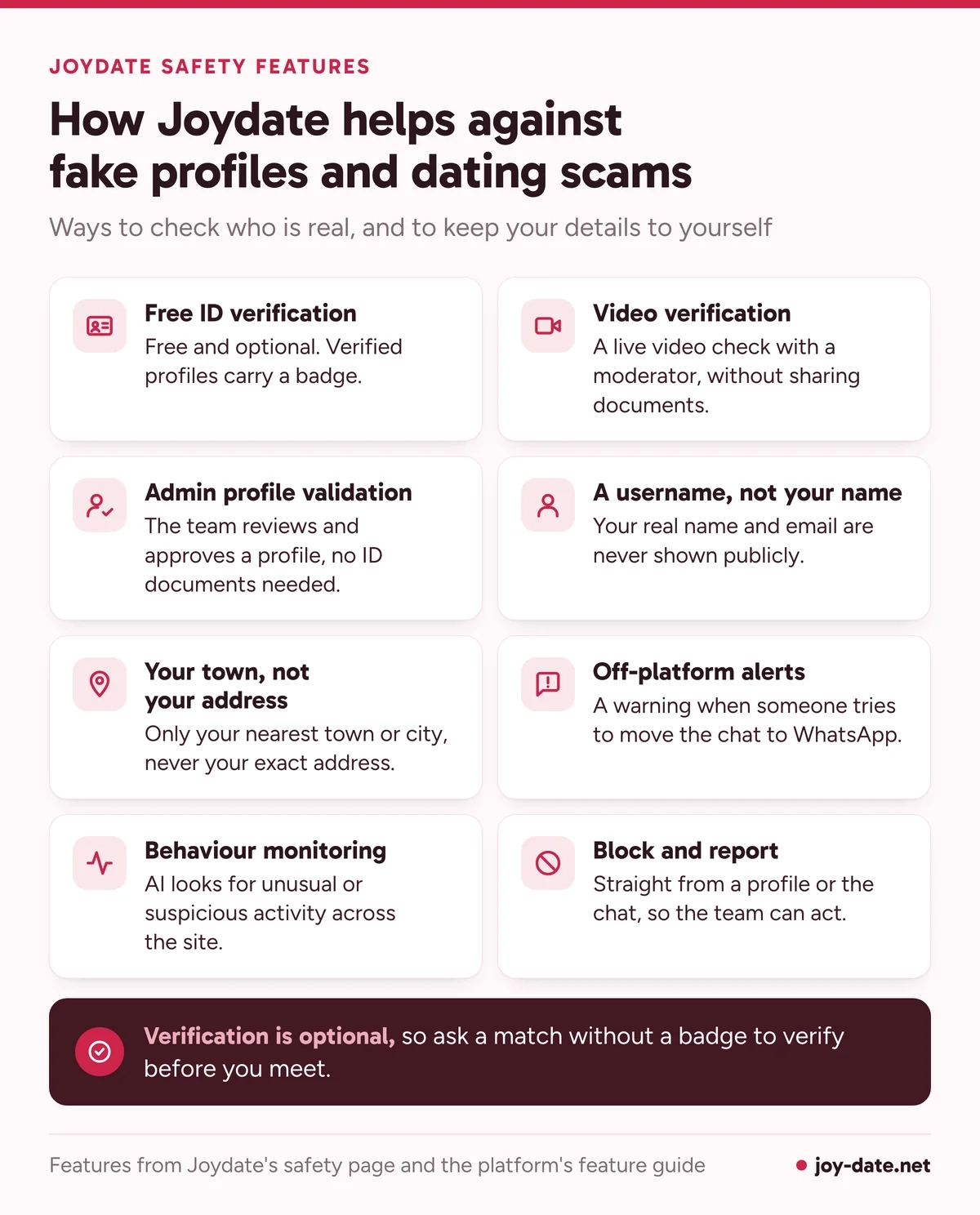
- A Verified badge. The ID check is free for every member, and passing it puts the badge on the profile.
- A live video check. A moderator confirms on video that a member is who they say they are, with no documents needed.
- Your details stay yours. A match sees your username and nearest town, not your name or where you live.
- A warning when someone pushes off the site. Joydate flags it when a match tries to move you to WhatsApp or another app.
- Block and report in one step, straight from the profile or the chat.
Are there fake profiles on Joydate?
Joydate, like every dating site, can attract scammers, and its terms are open about one more point: the company may run staff profiles, managed by employees, to test that the service works. That is why the verification badge matters. Report anything that feels wrong; Joydate's terms say content complaints are reviewed and resolved within five business days. The honest look at Joydate covers the rest.
What is sextortion, and what should you do?
Sextortion is when someone threatens to share intimate pictures of you unless you pay. New Zealand's Netsafe advises not to pay or send more, to stop replying and block the person, to take screenshots of the threats and to report it to the platform and the police. Paying rarely ends it, and the shame belongs to the blackmailer, not to you.
Fake dating profiles: quick answers
How can you tell if a dating profile is fake?
You can tell a dating profile is fake when several signs come together: photos that look too professional or turn up elsewhere in a reverse image search, very little real information, feelings that grow very fast, a push to move off the app, and any request for money.
What do dating scams usually look like?
Dating scams usually start with a fake profile that builds trust and then ask for money for an emergency, a debt, travel to meet you or an investment, often by gift card, wire transfer or cryptocurrency. Others ask for personal details or intimate photos, which can lead to sextortion.
Should you report a fake profile even if you lost nothing?
Yes, report a fake profile even if you lost nothing: reporting it on the dating site helps get it removed, and reports to official scam-reporting services help them warn others.
Does Joydate verify its members?
Joydate verifies members who choose to: every member can take a free ID check that adds a verification badge, or a live video check with a moderator. Verification is optional, so it is worth asking a match to verify before you meet.
Free to join
Date safely on Joydate
Free ID verification, your town only, and block and report in one step.
Join free